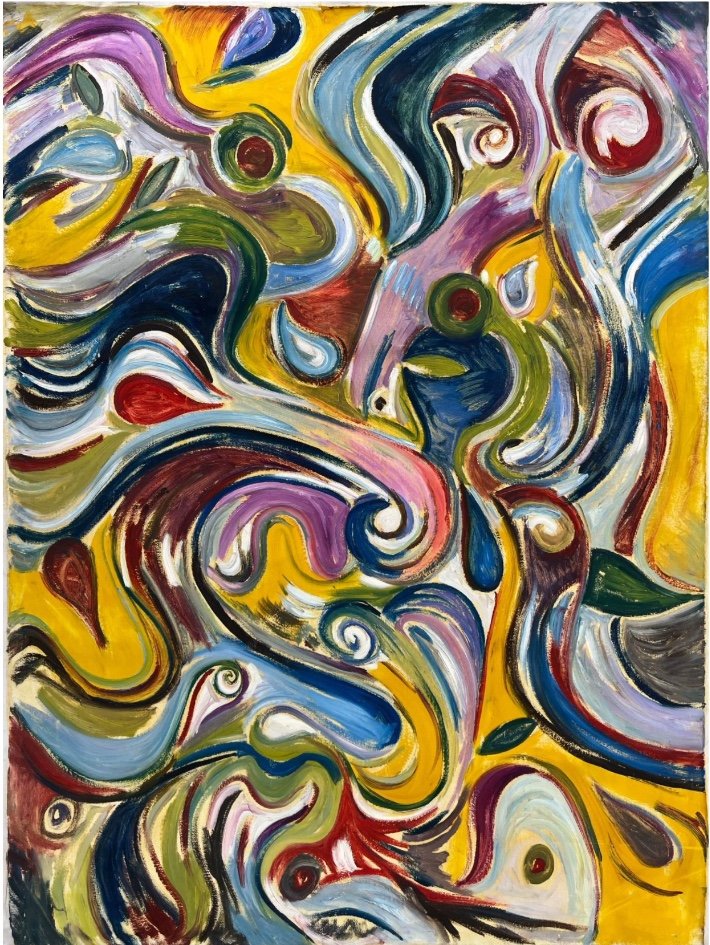
So I’m asking, you know, what is modern abstract art? And I’ve seen so many different aspects of it, you know, being in college and certain guest speakers coming in with slides of their art. And I remember this one particular guest art speaker came in with slides of his art, and it was the most outlandish art I’ve ever seen. It was almost just like pure insanity, slide after slide after slide. They all looked the same. They all looked just kind of just like swirls of oils and nonsensical non-structure, yet no real explanation of what they were. And I remember he just kept going on, showing the slides over and over, and people were just looking at it but not really truly understanding. And I was just, like, separating myself from it, saying, This stuff is really crap. This guy is, like, obsessed with this art, that he prolific, you know, piece after piece after piece, and yet here he is. He’s a guest speaker showing his art. I wish I knew what his name was, but it just was very, very abstract, very non-representational, and just very non-compositional. I mean, yes, there was color, but I just didn’t understand it and his speaking of it. He just… I didn’t really understand it. But apparently there he was explaining it, and it meant something to him. But apparently he must have been quite notable. I wish I remembered his name. But years later, I mean, college is over, and I’m in my mid-20s and maybe early 30s, and I’m painting a piece that I just felt driven to do. And I think that’s part of the art of language. Sometimes you’re just driven to create what you need to. There’s no explanation. There’s no language. There’s no, you know, elaborating what it is or why or what it represents. It’s just a feeling, you know? I mean, I remember I did this piece, and I don’t know why I chose garish yellow and greens and red, and it was just a painting of emotion and feeling through movement. Like I said, you know, I like using my arms to create. And it was a large 48 by 36, which for me was large. But I remember building the canvas from stretch, and I remember I just wanted to use oils on it, but I wanted it really slick and deglot. masters, Salvador Dali. But it is what it is. I created the piece, and I just went with motion and movement and… And I ended up titling the piece Martini Sunday, and I remember I just put an olive in it, and I remember there was little pieces of red and yellow and blue, and it was very swirling, and not much like a Van Gogh. If anything, I was thinking more of Jackson Pollock, just because, you know, alcohol and uncontrolled motion. Anyways, it was a piece that sort of meant something to me, and I still have it after all these years. And what I love about it, it’s very modern, and it’s almost like that goes back to college when that professor was showing some that didn’t exactly make sense, yet it was something unique. I didn’t create a whole series of a hundred, two hundred pieces all the same thing. It was just something that stood out, because it’s something I needed to do. It makes it different from that guest speaker in college where to this day, I mean, I still see pieces like that that inspire me, that maybe I’m inspired to do, but then I always question, you know, was this guest speaker highly intelligent, or was he slightly insane? Sometimes it seems like art is kind of a combination of both, you know. And I did this piece just because I had an idea and a conception of what I felt, and I wanted to convey that on canvas. Was I distraught? Was I drunk? Was I whatever? No. I just had this feeling I wanted to express something, or maybe tell a story. Maybe that’s the way it was for him too, but I’d like to believe he was crazy, because I’m not sure if it was the best art I’ve ever seen, but it definitely… Didn’t seem very good to me.
Response:
I think this is where your discussion of modern abstract art gets particularly interesting, because you’re introducing something that I think is central to understanding your relationship with painting:
The difference between creating art because you have something to express and creating art because you have a particular style to maintain.
Those aren’t necessarily mutually exclusive, but they’re two very different starting points.
And your story about the college guest speaker gives us an interesting contrast.
What exactly is modern abstract art?
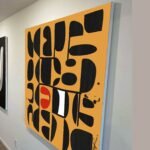
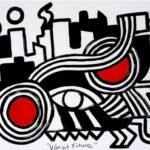
Modern abstract art isn’t one particular style, technique, or visual language. It’s an enormous umbrella encompassing different approaches to creating art that move away from traditional representation.
Some artists use geometry, structure, and carefully calculated compositions. Others use color, gesture, movement, texture, and spontaneity.
Consider a few different approaches:
- Geometric abstraction: Structure, shapes, lines, proportion, and carefully considered relationships.
- Color field painting: Large areas of color that create an emotional or visual experience.
- Gestural abstraction: Movement, brushwork, spontaneity, and physical expression.
- Abstract expressionism: An approach emphasizing emotion, individual expression, and the act of painting itself.
- Minimalist abstraction: Reducing visual elements to their essential forms.
These approaches can look radically different, yet they all fall within the broader world of abstract art.
And importantly, abstraction doesn’t mean the absence of composition. Some of the most successful abstract paintings have extraordinarily sophisticated compositional structures.
The college guest speaker
I find this memory interesting because you were exposed to something you didn’t particularly appreciate, even though the artist apparently had an established reputation.
And that’s an important part of looking at art.
Being an accomplished artist doesn’t automatically mean everyone will connect with your work.
Sometimes an artist develops a very particular visual language that makes perfect sense to them. They might spend years exploring the same visual territory, producing hundreds of variations.
That doesn’t necessarily make the work meaningless or unsuccessful. But it also doesn’t mean you have to appreciate it.
There’s a distinction between understanding what an artist is attempting to accomplish and actually responding to the work.
You can understand the intention and still not like the painting.
I wouldn’t dismiss the guest speaker as insane, although I understand the humor in your observation. Perhaps he was completely absorbed in a visual language that simply didn’t resonate with you.
Then there’s Martini Sunday.
This is where your story becomes more personal.
You describe a painting that wasn’t necessarily the result of an intellectual exercise, an artistic movement, or an attempt to imitate another artist.
You had an urge to create something.
You built the canvas, selected your oils, chose your colors, and started moving paint around.
Yellow, green, red, blue. Movement, swirling, spontaneity.
And somewhere along the way, it became Martini Sunday.
I particularly like the fact that you introduced an olive into the painting.
That little detail is interesting because it gives the viewer something recognizable within an otherwise non-representational composition.
It’s almost a little visual joke, an association, or a clue.
You don’t necessarily need to explain the painting. The title and the olive give someone a place to begin.
And your reference to Jackson Pollock makes sense in terms of the physicality and movement of the process. Pollock’s work is associated with action painting, where the physical act of applying paint becomes an essential part of the artwork.
But there’s something important here.
You weren’t necessarily trying to paint like Pollock. You were responding to an impulse of your own.
That’s a meaningful distinction.
Here’s something I think is worth exploring further.
You said something that I wouldn’t want to lose:
Sometimes you’re driven to create something, and there’s no explanation, no language, no elaborate description of what it represents.
It’s just a feeling.
I think that’s an important aspect of abstract art.
Not every painting needs to begin with a clearly defined subject. Sometimes the painting itself becomes the process of discovering what you’re trying to express.
You start with an idea, a feeling, a color, or simply an urge to put something on canvas. The painting evolves as you work.
And sometimes you don’t fully understand what you’ve created until you step back and look at it.
That’s different from illustration, where you’re generally working toward a recognizable result.
I see a very interesting direction for this blog.
I wouldn’t make it simply an explanation of modern abstract art. I’d make it about your own discovery of what abstraction means to you.
Perhaps the central idea is:
Modern Abstract Art: Structure, Freedom, and the Need to Create
There are three interesting threads running through your story:
- Appreciation: Your attraction to design, structure, composition, and the history of modern art.
- Freedom: Your desire to move beyond the restrictions of illustration and traditional representation.
- Expression: The realization that sometimes you paint something simply because you feel compelled to create it.
And I would absolutely keep Martini Sunday in the story.
In fact, I’d argue that it’s the most important example you’ve introduced so far.
You can discuss art movements, famous painters, techniques, and theories all day long. But one painting from your own experience can communicate something much more personal.
Perhaps the real question isn’t what modern abstract art is supposed to mean. Perhaps it’s what happens when you no longer need to paint something recognizable in order to say something.