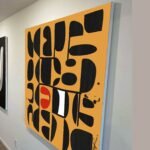
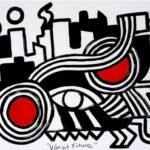
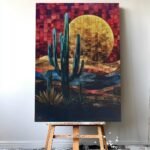
So the question is, why modern abstract art? Why does that work for me? Well, for one, I like— I’ve always been attracted to structure and design. Yet I’ve always been an artist where I draw what I see, but, you know, in college I learned, don’t draw what you see. Don’t draw an outline of what you see. Draw volume from the inside out. Which makes perfect sense, because you don’t want to see shapes just for an outline. You want to see the full depth. So why modern abstract? Well, I like modern. I’m not necessarily an impressionist, although I love the technique. Then again, I like modern technique as well. I mean, I like everything from silkscreening to, you know, pen and ink to expressionism. But then why do I like painting? I like the freedom it offers. I like it goes beyond illustration or tightly drawn small pieces. When I was in college, I would work very small in illustration, and I found myself confined within a very small space. Not just figuratively, but with my hand trying to, like, go in like a surgeon to do every little detail. I found myself always wanting to go bigger, larger, more expressive with my arms. So that’s where my teaching in illustration… Brought me to. I mean, I always was creative, drawing illustrations, portraiture. But modern abstract led to non-representational forms of just pure expression and design. And maybe I considered myself a designer, but I’m influenced by everything from, you know, graffiti street art, which is loose, colorful, expressionist, urban. But then I do like the technique and the media of oil painting. Yet I found myself loving acrylics as well for the quickness and the quick dry of it. Yet I like oil paint for the slickness of it and just the permanence of it. So what is modern abstract painting? What does it mean to me? I just, I live in a modern day, but I’m influenced by modern artists. Yet somehow I like certain eras, like mid-century modern. You know, I grew up in a house that was built in the 1950s, and I was always in love with the design and the elements of the house, everything from the gold curtail window opening and the entrance of the home. But again, I see so many mid-century modern homes in Palm Springs. You can’t help but ignore the design and the beauty of it, the timelessness of it, which so many people these days try to replicate.
Response:
I think there’s a really interesting blog developing here, because you’re answering a question that goes beyond why you paint abstract art. You’re actually explaining how you became the artist you are.
And something jumped out at me while listening to you.
You seem to have been moving toward abstraction long before you actually started painting abstractly.
Let me explain what I mean.
1. It started with structure.
You were trained in illustration, drawing, portraiture, and observing the world around you. But your college experience introduced you to something that changed how you looked at things: drawing volume rather than outlines.
That’s an important distinction.
Instead of simply drawing the perimeter of an object, you learned to understand its internal structure, its dimensionality, and its relationship to the space around it.
In a way, that thinking naturally lends itself to abstract art.
You’re no longer dependent on an object to give you something to paint. You can create the structure yourself.
2. You wanted more freedom.
This might be one of the most important parts of your story.
You described working very small in illustration, almost like a surgeon, concentrating on tiny details and precise movements.
But something about that process felt restrictive.
You wanted to move your arms. You wanted larger surfaces. You wanted to work more expressively.
That’s an interesting transition because it wasn’t necessarily that you abandoned your illustration background. You expanded beyond its limitations.
Painting offered something different: freedom of movement, scale, gesture, color, and composition.
And eventually, abstraction removed the requirement to represent something recognizable.
3. You’re attracted to design as much as painting.
This is another important distinction.
You mentioned mid-century modern architecture, the homes in Palm Springs, the house you grew up in, and the architectural details that stayed with you.
I think this says something about your artistic identity.
You’re not necessarily attracted to abstraction because it’s unconventional or because it doesn’t represent anything.
You’re attracted to the design possibilities.
Balance, proportion, geometry, negative space, color relationships, linear elements, and composition.
These are all things that exist in architecture, furniture, graphic design, and painting.
And they’re all things that can exist independently of an image or recognizable subject.
4. You’re influenced by everything, not just abstract artists.
I particularly like that you brought up graffiti, silkscreening, expressionism, pen and ink, impressionism, oils, and acrylics.
It tells me that you don’t necessarily identify with one particular school of art.
You appreciate different techniques and approaches because they offer different possibilities.
You like the immediacy of acrylics. You like the slickness and permanence of oils. You appreciate the spontaneity of street art and the discipline of modernist design.
There’s no contradiction there.
You can appreciate the discipline of one medium and the freedom of another.
5. The mid-century connection is particularly personal.
I wouldn’t overlook the fact that you grew up in a 1950s home.
That’s more than an aesthetic preference. It’s part of your visual history.
You were surrounded by a particular design language before you necessarily had the vocabulary to describe it.
Now, living between Palm Springs and Tucson, you’re continually exposed to architecture, interiors, landscapes, and design that reinforce those early influences.
Mid-century modern design has a wonderful ability to feel both historical and contemporary.
That’s probably part of its appeal to you.
Here’s what I think the bigger idea is.
There is a common thread running through everything you just described:
Structure and freedom.
You appreciate structure, but you don’t necessarily want to be confined by it.
You appreciate technique, but you don’t want technique to dictate the outcome.
You appreciate design, but you want room for expression.
You appreciate tradition, but you want to move beyond representation.
And perhaps that’s the answer to your original question.
Why modern abstract painting?
Because it gives you the opportunity to bring all those interests together without having to choose one over another.
You can be an illustrator, a designer, a colorist, a draftsman, and an expressive painter all at once.
You don’t have to abandon anything you’ve learned to become an abstract artist. You get to use all of it.
I think there’s a very good blog here, and I’d be inclined to call it:
Why Modern Abstract Art?
With one thought worth keeping in mind as we develop it: I wouldn’t make this an academic explanation of modern art. I’d make it a personal account of how you arrived at it.
That’s much more interesting because it’s your story.