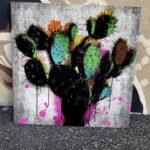
I was just thinking right now, art is a luxury not everyone can afford to buy. I mean, if you think about it, art is free. Art is something you should be able to witness, experience, and, you know, there’s plenty of galleries and museums where you can do that. But to actually own a piece of art seems so fabricated in a way, because you have to, like, put a monetary dollar on owning something or collecting something when it just, you know, it’s great because it values the artist in their lifetime, but then at the same time, it’s like right now, the economy, people can’t afford two, three hundred dollars. People can’t afford five thousand dollars, in the United States anyways. You know, I’m living in the United States, and I’m going through this rut right now where people really have proved that they want a custom commission, and they’ve contacted me because they’ve seen my name and my style on Facebook Marketplace, and then they, you know, they DM me, and I say, Hey, well give me a call. Let’s talk about it when you’re ready. And that seems to be the strongest motivator of getting my last two sales or three sales. You know, my biggest sales have been my last four or five clients have, like, wanted something for me to paint for them. But then talking about art is a luxury, you know, I’m, like, doing all this advertising right now to get people excited about a sale, or, you know, you can get all this for three hundred fifty dollars with free shipping, and nobody is jumping up and down about it. Now, it may open up some avenues for some custom commissions, but it’s pretty rough right now for an artist that’s trying to sell to any tier of buyer. But then it gets me back to my original question: art is a luxury. You know, should you be able to have to afford it? Should it be free? What about going to museums and seeing art, traveling, seeing it? Why do you have to own something just for mere decoration?
Response:
I think you’re touching on something much bigger than the difficulty of selling paintings. You’re questioning the relationship between art, ownership, money, and the actual experience of creativity.
And there’s a contradiction in the art world that I think is worth exploring.
Art is one of the few things in life that can give you something without requiring you to own it.
You can stand in front of a painting at a museum for twenty minutes and have an extraordinary experience. You can walk through a sculpture garden, visit a gallery, see a mural on a building, or look at architecture. You don’t have to purchase anything. You don’t even have to know who made it.
The experience is yours.
1. Art is free, but ownership has a price.
Think about that for a moment.
The artist creates something. The public can experience it. The work can inspire someone, change someone’s perception, bring back a memory, or simply make someone happy.
None of that requires a transaction.
But the moment you want to take that experience home, something changes. Now there’s a price attached to it.
And that’s where the art business enters the picture.
We put monetary value on something that, at its core, is an expression of human imagination.
There’s nothing inherently wrong with that. Artists have to make a living. Their time, experience, materials, creativity, and years of development deserve compensation.
But we’ve also created a culture in which owning original art can feel like a privilege reserved for people with disposable income.
2. Maybe we’re confusing appreciating art with owning art.
I think this is an interesting distinction.
You don’t have to own a Picasso to appreciate Picasso.
You don’t have to own a Warhol to understand what he was trying to communicate.
You don’t have to spend $5,000 on a painting to have a meaningful relationship with art.
Sometimes the experience is enough.
And perhaps we’ve placed too much emphasis on collecting, decorating, investing, and owning, rather than simply experiencing what an artist has created.
That doesn’t diminish the importance of ownership. It just puts it into perspective.
3. But here’s where your experience as an artist becomes interesting.
You mentioned something I wouldn’t overlook.
Your last several successful sales have involved custom commissions.
People contacted you because they recognized your name, had seen your work, liked your style, and wanted something created specifically for them.
That’s different from someone scrolling through Facebook Marketplace and seeing a $350 painting.
With a commission, they’re not simply buying a painting.
They’re buying an experience.
They’re participating in the creative process. They’re communicating an idea, discussing colors, dimensions, and possibilities. They’re developing a relationship with the person making something for them.
They’re buying something that didn’t exist before they contacted you.
And I think that distinction is important.
Perhaps people aren’t necessarily responding to another sale or another discounted painting because they’re not looking for another decorative object.
But when they have an idea of what they want, suddenly there’s a reason to spend money.
That doesn’t mean your existing paintings have less value. It means the motivation to purchase can be very different.
4. The economy has changed the psychology of buying art.
I also think you’re recognizing something that a lot of artists don’t want to acknowledge.
Even $300 or $350 isn’t necessarily an impulse purchase anymore.
People have mortgages, rent, insurance, groceries, car payments, and credit card balances. They’re being selective about what they bring into their homes.
And when someone has to choose between something they need and something they want, art often falls into the second category.
That’s not a reflection of the quality of the artwork.
It’s a reflection of the financial environment.
And I wouldn’t interpret a lack of response to a sale as proof that people don’t appreciate what you’re doing.
5. There’s another way to look at the whole thing.
I want to challenge one part of your original thought.
You asked why someone needs to own a painting just for decoration.
Maybe they don’t.
But perhaps decoration is selling art short.
A painting can become part of someone’s everyday life. They see it when they wake up, walk past it going to the kitchen, sit in front of it at night, and gradually develop a relationship with it.
Something that initially attracted them visually might eventually remind them of a particular time in their life.
That’s not merely decoration anymore.
That’s personal expression becoming part of someone’s environment.
And that’s something museums can’t quite provide. You can experience a thousand paintings in a museum, but you can’t necessarily live with them.
Here’s the thought I keep coming back to.
Art doesn’t need to be owned to have value. And owning art doesn’t necessarily determine how much someone appreciates it.
Those are two entirely different things.
An artist creates because there’s something inside them that needs to come out. The world gets to experience that expression. Sometimes somebody decides they want to live with it, and they’re willing and able to pay for it.
That’s a beautiful exchange.
But the exchange shouldn’t be the entire reason art exists.
And maybe that’s the part worth remembering when you’re going through a difficult selling period.
You haven’t lost the reason you started painting simply because people aren’t buying paintings this week.
Your creativity and your artwork have value before anybody puts a price tag on them.
The art is the experience. The painting is the object. The ownership is the transaction.
Those three things are related, but they aren’t the same thing.
And honestly, I think there’s the beginning of a very interesting essay in what you just said.